This article is copied from NewWorld Report
It brings great insights into what shape modern campaign is taking. It requires a high level of strategic organising and a strong team, but it can be carried out with limited funding.
Its structure is very inspiring and worth looking into
——-
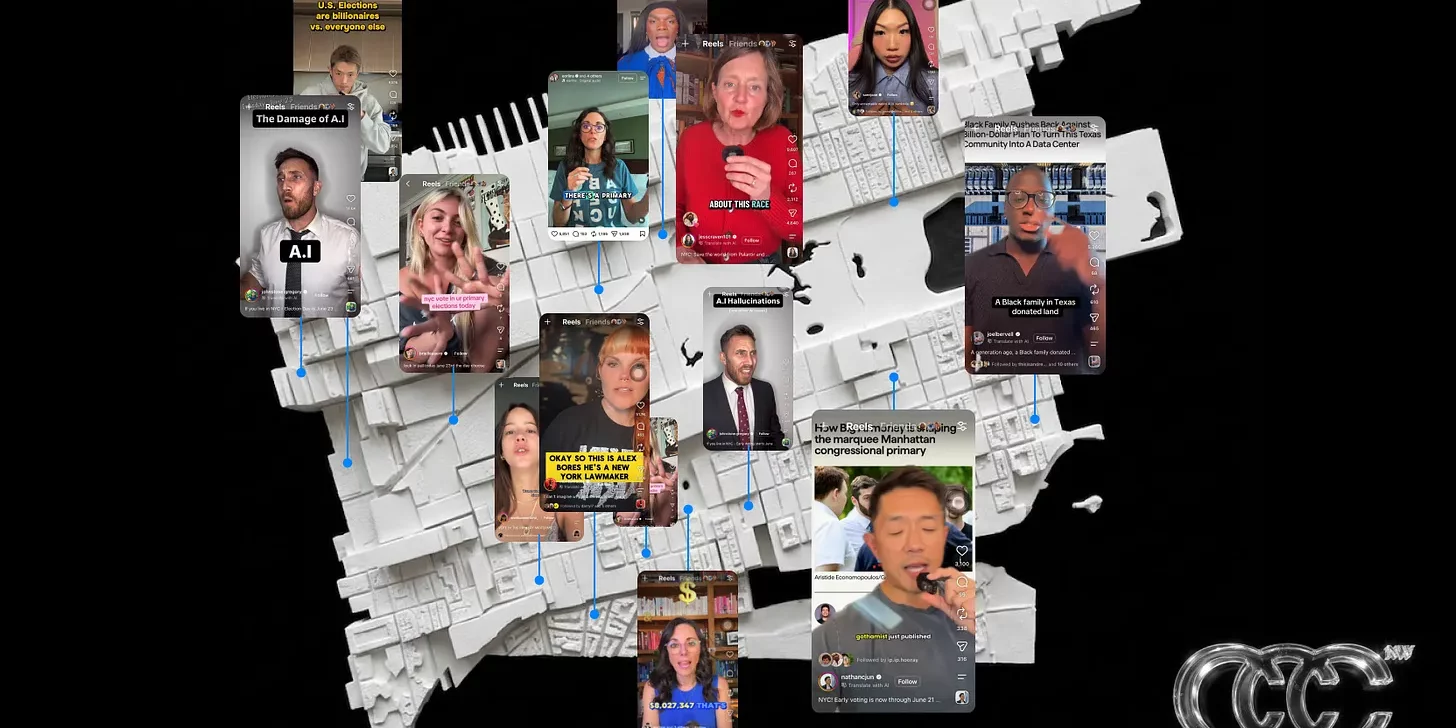
Earlier this summer, NewWorld partnered with Ground Floor Public Affairs and Unfiltered Media on an independent expenditure Creative Command Center supporting Alex Bores in the NY-12 Democratic Congressional primary.
 |
In June, OpenAI launched a $100 million Super PAC backed by a range of industry leaders (notably, not Anthropic), with a stated mission to attack political candidates whose AI-regulation agendas they wanted to derail. The new PAC sunk $10 million into the NY-12 race to defeat Bores, an outspoken proponent of common-sense regulation and, as a New York State Assembly Member, the author of a groundbreaking AI safety law. Bores entered the race as the least-known candidate in an extremely well-funded, very crowded field. He was slowly rising in the polls thanks to the stellar work of his campaign, while voters’ feeds and mailboxes were filling up with industry-sponsored attack ads against him.
NewWorld’s job was to organize the pushback and make sure voters met the real Alex Bores: a principled progressive and credible champion of AI regulation. But it was also to make the bigger statement that New Yorkers—not shadowy, self-interested, billionaire-backed PACs—should get to pick their representatives.
Over the last two months of the campaign, our Creative Command Center did just that, keeping a consistent narrative in front of voters every single day until it was time to cast a ballot. In total, our handpicked cohort of 18 creators launched 90 pieces of original content, resulting in:
- 22 million views and more than 1 million engagements in a district of 750,000 voters
- 3x the industry engagement benchmark for comparable content
- Nearly 12x the engagement of paid media on the same race
- Elevating Bores to national prominence as a leader on AI safety
Bores came within 4 points of winning the race, a massive leap compared to where he started. More importantly, the country took notice. Two months later, his standout performance has made him a rising star in politics and minted him as the face of common-sense AI regulation in the country.
How We Did It
Weeks 1-2: Rapid Deployment
When we kicked off the project, the campaign had 2 months left, and speed was paramount. Every day without our content on feeds was another day PAC-funded attacks went unanswered, and another day they worked to define who Alex Bores was for voters who didn’t know his name or his platform.
Our research team immediately built a profile of younger NY-12 voters, focusing on their tastes, social media diets, and creator allegiances. This gave our strategists what they needed to start recruiting a cohort of creators this audience was likely to trust, with the best chance of breaking into their feeds organically, not as advertisements. Content delivered inside the feed beats advertising that interrupts it.
Within a week of the first conversation with our partners, we fully stood up operations. The following week we went live with 5 pieces of content from 3 creators, attracting half a million views.

@elizaorlins, a NYC public defender with over 1M followers, rips into OpenAI for child safety abuses and emphasizes the importance of leaders like Bores fighting back
Weeks 3-5: Scaling the Cohort
By mid-May, polling showed Bores gaining in vote share and eating into Jack Schlossberg’s base of support. Schlossberg (a Kennedy with a large social following) had built his campaign in the feeds. But that was terrain we were now competing in, and winning daily.
Our creator cohort grew to 9, then 14 by the end of the month. Coordinating a cohort that size takes a system. Always-on social listening tracked how the race moved day to day, feeding weekly briefs that gave every creator bespoke messaging direction and the context and facts behind it. Because we continuously tracked content performance across the cohort via a custom dashboard, each creator brief was informed by how the last round of content landed.
 |
We designed the Command Center model to leverage the power of creators, not by commandeering their feeds, but by giving them creative freedom to produce content grounded in their own unique voice and talents. The Command Center doesn’t hand out talking points — our briefs suggest messaging as guidance, not a script, and our research gives them the confidence to make every piece their own. And that they did.

@HarrisAlterman skit of ChatGPT as a disastrous babysitter got people laughing before it landed on what was at stake in the race.
Weeks 6-7: Precision Amplification
Every piece of content the cohort produced was a test. When one broke through, like Eliza’s post on child safety, we flagged it to the independent expenditure’s paid buyers (led by digital advisor Gabby Zutrau) so they could put money behind it. We amplified what audiences were already responding to, rather than guessing where to place paid media based on our own tastes.
In the final stretch, we pointed that capability at the precincts below Central Park, where Millennial voters making up Bores’ base were overrepresented. We ran a varied mix of content into those neighborhoods matched to these distinct audiences. The targeted push drove 2.3 million views in the final week alone, and Bores won these precincts handily.


Monte Mader went viral with this GOTV post 4 days before the polls opened.
The organic-to-paid handoff was one of several ways the CCC coordinated across teams. Social listening reports kept everyone from ad buyers to GOTV canvassers reading the conversation the same way, and weekly check-ins kept strategy aligned across the effort. The NY-12 Creative Command Center was the hub.
Beyond NY-12
Creative Command Centers are rapid-response communications teams that combine research, creators, content production, and paid media to ensure the right narratives for the moment show up as organic content from trusted voices. In this case, that meant getting pro-Bores content in the feeds of NY-12 voters. In previous CCCs we’ve delivered anti-ICE memes in the feeds of Midwestern suburban moms, and placed info about recovery efforts and support in the feeds of disaster survivors.
In the future, it could mean so much more. Adaptability is the point. Affordability skits in the algorithms of Gen Z Hispanic Texans? Racial solidarity content on union workers’ For You pages?
You tell us. We built the model, customized the tools, trained the team – and designed it as replicable communications infrastructure adaptable to many problems and audiences.
A Creative Command Center is not right for everyone. It requires a desire to win in a new way, a clear idea of the conversation that needs to be created or interrupted, and a willingness to be interesting in public. What it does not require is a bigger budget than your opposition.
If that describes your campaign, your organization, or your issue, we are here to help and the inbox is always open: andre@neworld.inc.
Ipshita Raval contributed writing and analysis to this article.
About NewWorld