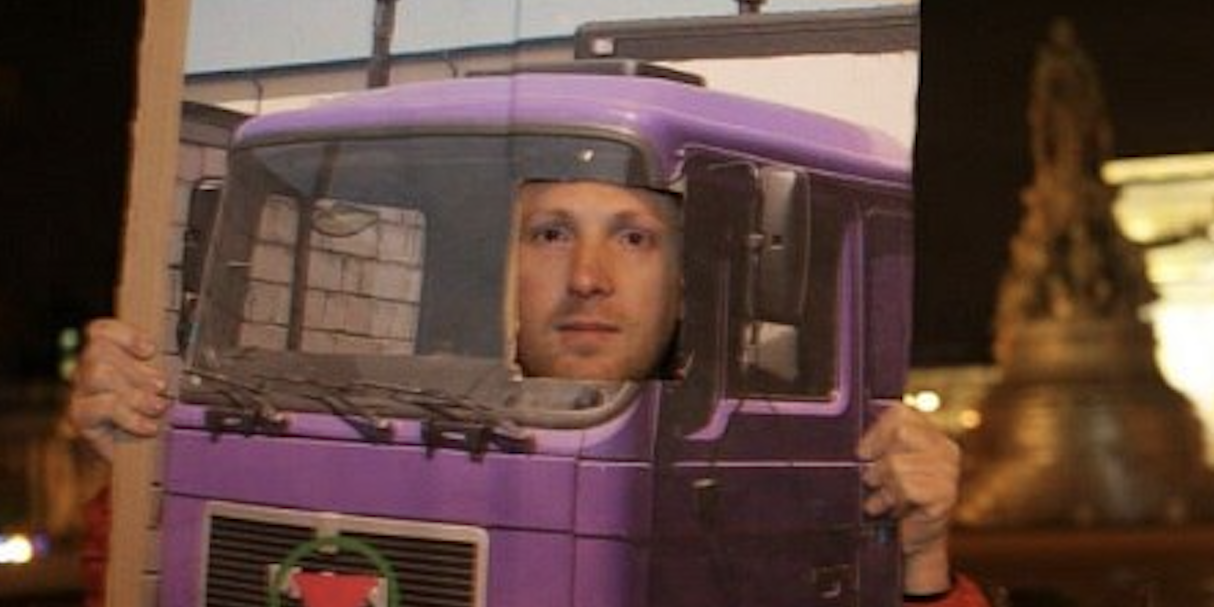
Between 2015 and 2017, LGBT activists in Russia joined forces to defend the rights of an unlikely group of essential workers….truck drivers! In doing so, they challenged stereotypes and helped reshape the narrative surrounding LGBT activism. This case offers a lesson in creative campaigning as described by campaign co-organiser Alexey Sergeev.
Context: Truck drivers protest against the “Platon” toll system
In late 2015, mass protests by truck drivers erupted across Russia in response to the introduction of a new road toll system called “Platon”. Officially, the funds collected were intended for road repairs, but the system was administered by a specially established private company owned by the Rotenberg family,close associates of Vladimir Putin.
Truck drivers reacted with outrage as the additional levy threatened to bankrupt many of them and to drive up consumer prices nationwide. Hundreds of drivers took to the highways, partially blocking traffic,some even prepared a “march on Moscow” if the system was not repealed.
The authorities sought to prevent a coordinated protest in Moscow. In early December, the police blocked trucks approaching the city. At the same time government-controlled media portrayed truck drivers as a “fifth column”: internal enemies allegedly manipulated by foreign countries..
In this environment, the truck drivers received little public support. Among traditional political forces, only the Communist Party openly backed their cause.
This is when LGBT activists from Saint Petersburg stepped in. Their involvement became a unique example of cross-movement solidarity between different communities under increasingly authoritarian conditions.
“The Alliance of Heterosexuals and LGBT for Equality”: origins and mission
Support for the truck drivers was initiated by the Alliance of Heterosexuals and LGBT for Equality, a movement founded in Saint Petersburg. This informal group emerged in the spring of 2012, following the adoption in the city of a controversial law banning so-called “homosexual propaganda.”
The Alliance was formed to challenge the false division between heterosexual and LGBT “camps” promoted by state propaganda and to demonstrate that many heterosexual people oppose the authorities’ homophobic policies.
As stated in its manifesto, “the Alliance is not focused solely on LGBT+ issues. We believe in solidarity, which is why we supported truck drivers, political prisoners, anti-war protests, urban preservation activists, the women’s movement, people with disabilities, and others. We are members of society, and we care about what is happening in the country,”
The Alliance regularly participated in broader civic actions and became a co-founder and active member of the coalition of civic, political, and human rights organisations “Democratic Petersburg”. At the same time, it developed its own distinct style of activism, organising initiatives that combined creativity with political messaging. These ranged from the annual anti-discrimination festival Equality Week, to creative street performances, such as the satirical “Aria of Milonov” composed entirely of insults delivered by a homophobic MP and performed outside the city parliament, or the Rainbow Coffin action commemorating victims of hate crimes.
How LGBT activists supported truck drivers: December 2015
The initiative was inspired by the UK campaign “Gays and Lesbians support the Minors”. In 1984 to1985, LGBT activists openly supported striking miners, which strengthened solidarity between the movements and eventually led miners’ unions to back LGBT rights. This episode was later portrayed in the film Pride, which had only limited distribution in Russia but had been seen by Alliance activists.
As protests against the road tax were largely ignored by major media outlets, the Alliance’s plan was to leverage the systematic media attention directed at LGBT issues to highlight the truck drivers’ struggle. Activists believed that visible LGBT participation could act as an “information battering ram,” helping to break through the state-sponsored silence surrounding the drivers’ demands.
The first step was to consult the Board of Alliance’s supporters.
“It was important for us to obtain a mandate from our supporters, to make it clear that supporting the truck drivers was not just our initiative but a demand coming from part of the Russian LGBT community. Hundreds of people took part in the poll, and the interactive engagement itself helped mobilise support”
— says Alliance member, activist, and campaign co-organiser Alexey Sergeev.
On 7 December 2015, the first solidarity action entitled “Today I Am a Truck Driver” took place in Saint Petersburg. Activists holding truck-cabin-shaped cardboards painted in one of the six colours of the rainbow flag and bearing the logo of the Alliance, marched in the city centre of Saint Petersburg chanting slogans in support of the truck drivers’ mobilisation.
To circumvent restrictions on unauthorized public gatherings, they organised a series of single-person pickets, with participants replacing one another sequentially. Unlike many LGBT pickets, which are often met with hostility, this action took place without incident.
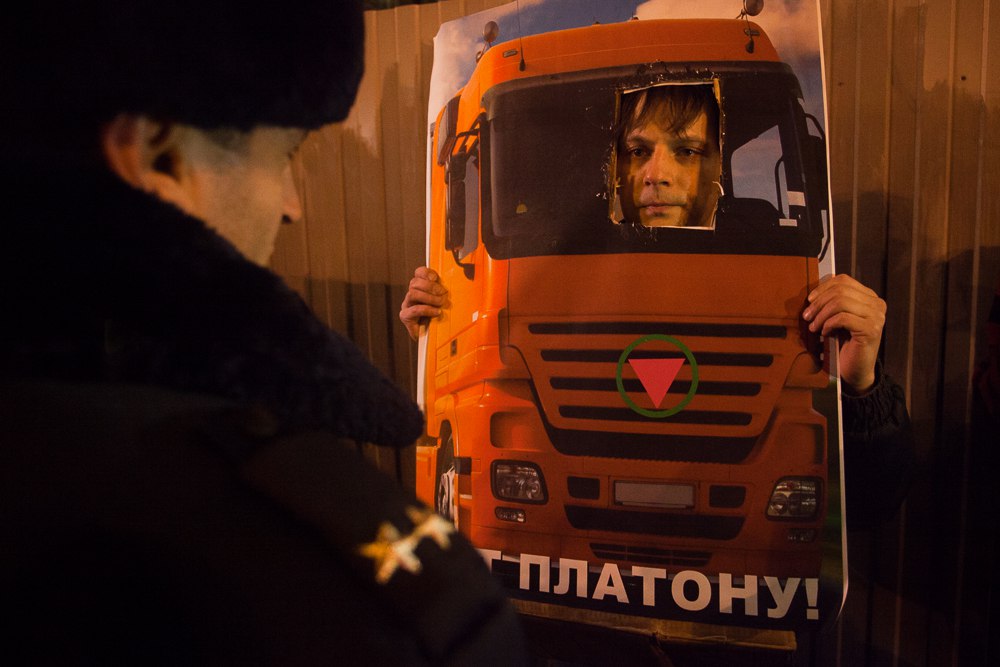
Photo: Activists of the Alliance of Heterosexuals and LGBT for Equality during the “Today I Am a Truck Driver” solidarity action on Nevsky Prospekt, Saint Petersburg, 7 December 2015 (Photo: all4equality.org).
In communications around the event, the Alliance underlined the parallel between the experiences of the LGBT community and the situation of truck drivers. It noted that the state employs similar methods against any group deemed to be “inconvenient”:
“Media silence, attempts to label groups as a ‘fifth column,’ hate propaganda, legislative pressure, and harassment by law enforcement—these are all things the Russian LGBT community has experienced in full. Today, much of this is being experienced by Russian truck drivers.”
The event attracted substantial media coverage, with more than 30 articles, most of them neutral or positive in tone. Only a few pro-government outlets reacted negatively. One claimed that the U.S. State Department had become disappointed in the opposition and was now funding “rainbow boys and girls” to destroy Russia. In response, activists joked about their “unpaid salaries,” even floating the idea of a mock picket outside the U.S. consulate demanding the “promised money”.
Support for the truck drivers did not stop there. Throughout the winter, activists visited the truck drivers’ protest camp outside Saint Petersburg several times, bringing food and supplies, meeting with drivers, and distributing leaflets. These personal interactions helped dismantle stereotypes on both sides. Many activists had assumed that the truck drivers would be hostile and homophobic, but they discovered that frequent travel across Russia and Europe had made many of them more tolerant than the average Russian. In turn, the drivers began to see the LGBT activists as allies.
Continuation of the Protests and the Campaign in 2017
In 2016, as some of the protesters’ demands were met and the intensity of the protests died down under State pressure, the LGBT support campaign was temporarily put on hold. However, in spring 2017, protests resumed across Russia and became increasingly political. Many drivers openly expressed distrust of the government and demanded investigations into corruption at the highest levels of power.
Against this background, the Alliance decided to revive its campaign. When city authorities banned a planned truck convoy through Saint Petersburg, LGBT activists reacted with a “toy motorcade” in the city centre. Thirty toy trucks, pulled along by strings, “drove” in a tiny convoy accompanied by a toy police car.
As placards were banned under the threat of detention, activists placed a volume of works by the ancient Greek philosopher Plato onto one of the toy trucks—a clever reference to the name of the hated toll system. This ironic action attracted the attention of passers-by and journalists, giving the truck drivers at the event an opportunity to communicate their demands to a wider audience through the media.
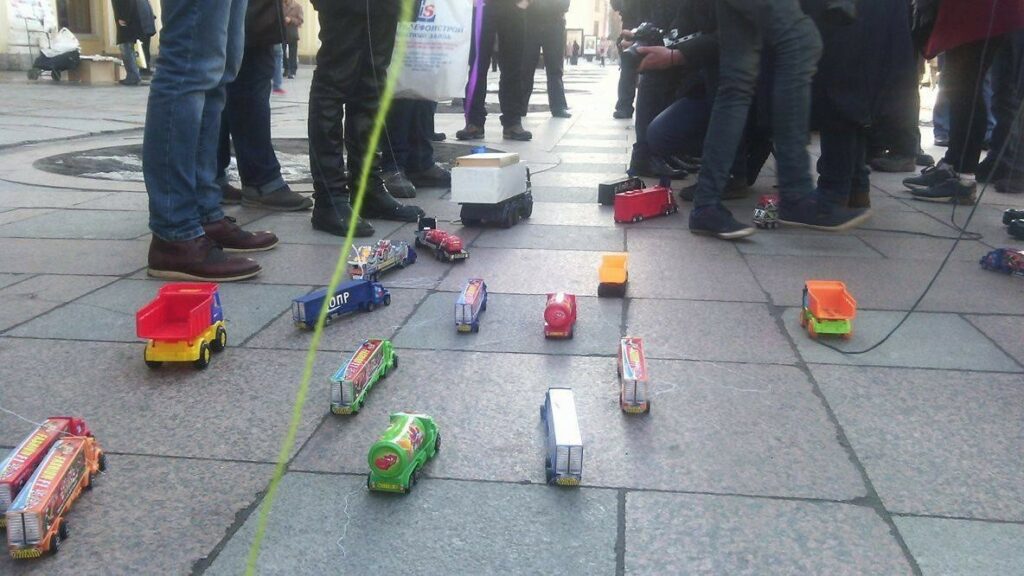
Photo: Toy motorcade on Nevsky Prospekt, Spring 2017. Source: LGBT Alliance
“The image of a toy convoy in the centre of Saint Petersburg attracted as much attention—if not more—than a real motorcade would have done, had it been permitted. This once again shows that creative activism saves resources and draws attention” claims Alexey Sergeev.
During a visit by activists to a protest camp, a 50-year-old truck driver made the following comments about LGBT people: “They are normal people, the same citizens as everyone else. The authorities are trying to pit us against each other. It won’t work!”
These words deeply moved and inspired Alliance members.
On another occasion, when journalists from tabloid media asked one of the truck drivers whether it was “shameful to stand next to gays,” he replied that “if these are the only people in the city with courage, then it’s an honour to stand with them.”
Through the creative campaign and personal interactions in protest camps and at demonstrations, cooperation between the Saint Petersburg truck drivers and the LGBT activists gradually evolved into genuine mutual support.
This story of solidarity culminated in a symbolic event that was very reminiscent of the ending of the film “Pride”. In the summer of 2017 a group of truck drivers displaying their organisation’s flags, joined the Saint Petersburg LGBT Pride to openly support the queer community and assist organisers with event security, a historic first!
Solidarity Under Pressure: Conclusions
At first, the idea of LGBT activists supporting protesting truck drivers seemed exotic to many observers. Even within the LGBT community, truck drivers were often perceived as predominantly conservative and distant from the agenda of sexual minority rights. Over the course of the campaign, activists realised that they too had been influenced by stereotypes.
In this story, both communities ultimately benefited from their cooperation. For the truck drivers, support from an unexpected and creative ally helped amplify the protest’s media visibility, communicate their demands to society, and circumvent restrictions on public actions—conditions that LGBT activists in Russia have long learned to navigate.
For LGBT activists, participation in the truck drivers campaign boosted support for their own movement. Many liberal-minded citizens may have seen LGBT activists for the first time not through the lens of state propaganda, but as equal participants in civic protest. The fact that LGBT people cared about “other people’s problems” challenged the stereotype of an insular LGBT community. One social media user commented “I didn’t expect this from them—well done for supporting working people.”
Of course, there was also mockery from homophobic circles, including sarcastic references to “gay truck drivers” by pro-Kremlin bloggers, but ultimately this only increased awareness of the protests.
The “Today I Am a Truck Driver” campaign remains a striking example of mutual support between social movements in contemporary Russia. LGBT activists in Saint Petersburg demonstrated that, in the struggle for civil rights, there are no “other people’s problems.” Their rainbow-coloured truck-cabin placards supporting truck drivers were not only a bold gesture but also a carefully calculated response to policies aimed at dividing society.
This case illustrates how creative solidarity can strengthen the resilience of protest movements even under authoritarian conditions and offer an inspiring example for activists worldwide.