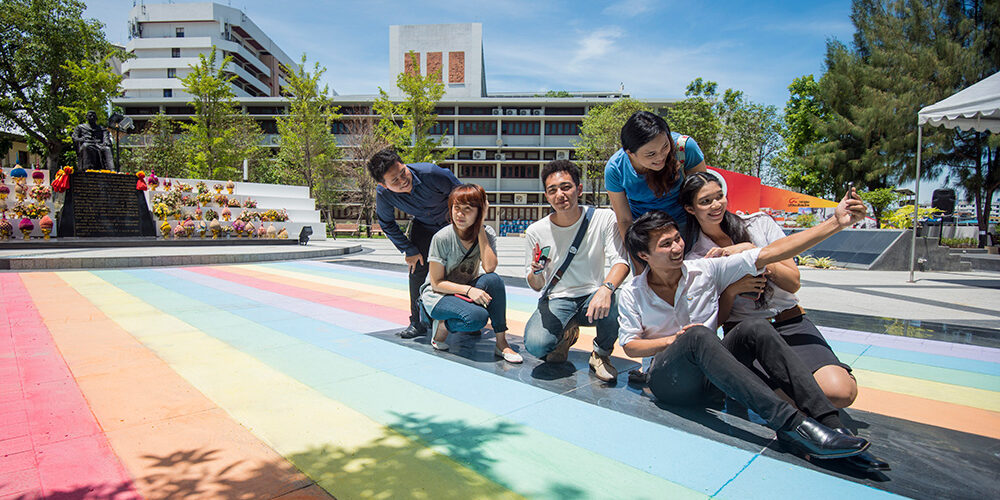
Rainbow chalk-ins or DIY Rainbow projects have grown massively in popularity over the past few years—from Sydney, London, and Toronto, and back to Bangkok, and beyond. They can make for visually impressive actions, which contest the exclusion of LGBTQI communities in public spaces, color city streets, and get people involved in community arts along the way.
This trend has been growing after Australian LGBTQI communities started taking matters into their own hands in response to Sydney City authorities deciding not to make their painted rainbow crossing a permanent feature of the city in 2013. Today, there are actions all over the world, many of which you can see in this gallery, put together by the DIY Rainbow Project.
One of the most impactful of these actions for IDAHOT 2014 was the School Rainbow Campaign in Bangkok, Thailand. Chalk-ins were organised in five schools on May 17, with the participation of young people, community organizations, school teachers and counsellors, and UN staff. Thai national television and press reported on the actions, and photos of the actions were shared all over the world during the week around IDAHOT. The campaign provided a way to publicize new lesson plans and information resources against LGBT bullying, and to open debates about discrimination in schools and public spaces.
Justine Sass from UNESCO, one of the organizations behind the scheme, told us more about how the campaign was organized—where the idea came from, what the team learned, and what advice they would give to others thinking about organizing something similar.

Thammasat University, 14 May 2014 © UNAIDS/A.Martin
How did the idea first come about?
So you may have seen that UNESCO and Plan International Thailand did a study last year focused on the extent of homophobic and transphobic bullying in the country. It was the first systematic study of its kind, involving 30 schools and 2,000 students.
As we had the preliminary findings available and were starting to review them with stakeholders, we were approached by staff from UNAIDS who were also starting some of their planning for IDAHOT. And we said, Look, we’ve got this piece of data here for Thailand, and we would be really interested in what we could do beyond the launch of the research results. We know that you get this kind of data, and it’s easy to engage some people, but it’s not easy to engage others. So, we wanted to do something that would bring the research into the media and be an opportunity for us to have discussions in schools. That was where the idea was originally formed.
So, a number of different agencies and organisations came together. UNESCO, UNAIDS, and then we wanted to bring some youth organizations on board, so we approached Youth Lead, which is an Asia-Pacific regional network working with young people from key populations. We also targeted Youth Voices Count, which is again a regional network specifically targeting young men who have sex with men and transgender people, then APCOM, which is the Asia-Pacific Male Coalition on Male Sexual Health, and YPC is actually a project of APCOM. So, all these major organisations were on board for the initiative.
As you can see, these are generally regional agencies which I will touch on later in terms of what I think are some of the lessons we learned because we didn’t have a local Thai partner that was directly involved in the initiative, although we had Thai programme staff that were assisting us with the planning. But it was one of the weaknesses, I think, in terms of the implementation of the initiative.
In terms of the timeline, it was about three months before IDAHOT that we started to do the planning, and that timeline was considered to be fairly tight, I would say.

Mathayom Prachanivet School, 16 May 2014 © UNAIDS/A.Martin
What were the major risks/obstacles you faced, and how did you work around them?
We had two major risks. One was that the school year started the week that we were planning the activity. That was enormously difficult for us, in terms of outreach to school administrators and planning with relevant people in the schools. We also had to go through some fairly official processes, where the schools were requesting an invitation letter from UNESCO. And then they had to go through a process of discussion within their school management committees, but their school management committees weren’t convening yet. So really, the most enormous hurdle for us was the timing of the Thai school year.
The other big planning issue for us was the rainy season, which doesn’t usually start in Thailand in May, but this year it started earlier than usual. And so when you’re planning an outdoor chalking campaign, you don’t want it to be washed away before anyone gets to see it. We were originally planning to do it in the evenings. So we were going to have students, teachers, and this community of young people to do the chalking in the evening, with a “reveal” moment the following morning, where the students would come into the school gates and they would see it, and interact with it, and we would have further discussions.
It became clear, as the day was approaching, that it was raining every night. The original plan was to have it at the front gates in each school, but often we had to change that to look at places where there might be some sort of overlay or cover. We’d also looked at whether we should put tarps up before. But we ended up doing it on the morning of the “reveal,” so we actually got to the school at 6 o’clock in the morning, which had pros and cons.
In terms of cons, the major difficulty that we had was getting people to come and do it. So originally, our community members were quite excited about doing the chalking in the evening, and were not happy about getting up there at 6 o’clock in the morning. So our teams got much smaller, and we had to be much more creative about what we were doing.
I would say the major pro with that strategy was that it actually wasn’t finished. So we had students coming in that were able to engage with us, beyond the team that we had put together. So we could actually have a lot more conversations, because they would come and say, what are you doing? Can I help? And they would pick the colors and take part in the designing. And so I think it helped us to engage with many more students than we would have.
We first made scoping visits to each of the sites, together with a local NGO representative and the photographer, to see where it might work best. And someone from the school was there for those visits. We were typically just looking for an arc, some sort of arc around the school. In one of the schools, it ended up being the school athletics track, and in another, it was a roundabout. And each of them was a public location where we knew they would get a fair amount of traffic.
And then on the day itself, people just took it the way that they wanted to. So there’s one, for example, the last one that we did, which is fantastic, like in the very true sense of the word, like these fantasy drawings within each of the arcs. And that was the teachers, the local students, and staff who had that idea and just went with it. So we knew where we wanted to do it and how it might look best, but the drawing itself was quite organic.
What did you learn from doing this action? What might you do differently?
I think this multi-partner planning process was really important, but I think there are also a couple of lessons that we could learn from it. One was the importance of having local youth organizations on board, to help with interactions on the day, and also because of the networks that they have, their capacity to share them with other organizations, and to help build the social media engagement that we wanted to get out of the campaign.
The other thing that we learned was the importance of having people in the schools who were really committed to taking it forward. In the schools that we did it in, it looked quite different. In the international school that we did it in, for example, it was the counselor, and that counselor was really interested in taking it forward because she had LGBT students who were coming to her and were struggling and who didn’t feel like they were getting adequate support. So she really was committed to doing more. In some of the other schools, it was the sex education teacher who was interacting with kids in sex education class, and was also realizing that gender identity and sexual orientation were not adequately explored in the curriculum. And in some, it was really the principal, and that was really exciting for us, because it had that high-level senior engagement of the school staff, and in and of itself, which was really important.

New International School of Thailand (NIST), 15 May 2014 © UNAIDS/A.Martin
Did you originally plan to do a national-level campaign, and how many schools did you plan to involve?
Originally, we were looking at what we might do on a regional level, and we felt that with the timeline, and due to us being here in Thailand, and us having the data and having a real platform for discussion, we wanted to start in Thailand, and then possibly do it in other countries as well. So we really focused on Thailand in particular. And in terms of the number of schools that we wanted to do it in, we didn’t have a fixed number. My original thinking on it (and I might have been in the minority) was that I wanted to do it in as many schools as possible. But the feeling was that there was a certain risk to that: if the school wasn’t adequately invested in supporting follow up, we shouldn’t be doing it, because we might be putting LGBT students, or those who are perceived to be, at risk of violence, which is exactly the thing that we were trying to avoid. We also had this problem at the start of the school year.
So in the end, the number of schools shrank considerably. And it’s a really critical question to ask: do you want to go to the “low-hanging fruit,” where there’s already interest in taking this forward from the teachers and principals, or do you want to go to the more challenging settings? And I think because of the potential risks, we leaned more towards the “low-hanging fruit,” but with an advocacy strategy where we would try to reach out to the other schools through social media, through other media, and by making the lesson plans we’d developed available to any school that was interested in using them. And we looked at other media. We had our director make a statement in the Bangkok Post, for example, around IDAHOT. We also made this call to action in the video. We created this video at the end, which said, if any other schools are interested, please let us know, as we would be happy to help them out with materials and other types of support.
So out of that also came the social media activities that we did on Facebook, Twitter, and the video that was done after IDAHOT, which was done in English and Thai, and was also circulated through some of those same channels.
Watch the School Rainbow Campaign Video:
How much would you say this sort of initiative might cost?
For the purchasing of the chalk, we probably put in around USD$800- 1,000 in materials, and about half of that still remains (so, around $80-100 per school, for materials that were used). Aside from that, the main cost would have been around the production of the video and the translation of the materials. We also had a photographer who came on-site over the course of the week to take photographs of the campaign.
All of the outreach, planning, social media and communications was integrated into our usual work, so it was relatively low cost I would say. But the social media part I think was really really important. We didn’t put any money into seeding, or when you try to raise the profile of your video or campaign on social media. I’m sure that that may have had an impact on the relatively low impact that we had on social media. UNAIDS estimates that through their channels, they managed to reach about 850,000 people. I haven’t got the numbers on ours or on APCOM’s, but we were able to reach a lot. However, in terms of the likes and engagement that we got on YouTube, it had a relatively low impact. And that could probably have been improved if we had put more money into the social media aspect.
The other thing I think is that it is a lesson learned for us: the chalking in itself is one thing, and it’s great because you can have a dialogue with the people around it. But the follow-up is really important. And so in the schools that we engaged with, there was a follow-up in every school. And that looked different in every school, so in one it was an assembly, where the principal spoke at that assembly, and so that reached all of the school, more than 1,000 kids in that school, and it was a fantastic demonstration of the school’s commitment to the issue. In some of the other schools, particular lessons were introduced, or in one of the colleges, there was a fantastic open plenary panel discussion, with an artistic performance as well. But in each of them, it wasn’t just the chalking that was done; it was other things subsequent to it. And I think we need to be able to go back to those schools in six months and ask, “Have you done anything else? Would you like us to offer support in doing something further?” So that it’s not just about a one-off event but about the school’s ongoing commitment.
I think the team was really pleased with the overall impact of the campaign. It was picked up on Thai television, in the Thai media, and through other international sources, which is really fantastic. The thing is also for us that the campaign enabled us to have other people look into the research that we’d done. We also really wanted to have a discussion around the impact of homophobic bullying in educational institutions here, and I don’t think we would have gotten the attention to the issue that we got without linking it to the campaign. So I think yes, we’re very pleased. We would like to do it in more schools, we’d like to do it in more locations, and we’d like to see it in other countries as well. But I think that for what we were able to accomplish, with the financial investment we were able to make, within the timeline that we had, I think we got very good results.

New International School of Thailand (NIST), 15 May 2014 © UNAIDS/A.Martin
What advice would you give to other people who might be considering organizing something similar?
I think that one thing that is really important is outreach to schools; I am just thinking about how you make the approach and to whom you make the approach. And that might look different in different settings, depending upon which partners are involved. Again, as I say, we felt that having a champion within the school who would be involved beyond the chalk campaign itself was really important. The youth engagement as well, being able to say, if we do this in your school, we would really need the following: at least one teacher who is involved, several students who could come and join us, and some kind of follow-up, which could include assemblies, school lesson plans, etc.
Another thing we could have also done is have stickers that we handed out that linked people to the website or something else, like a flyer or some sort of handout. That could have been helpful. We could have reached more kids, I think, and maybe gotten more interest in the website and the resources that we have on it. And that could look different in different settings. It could be a hotline, or we could direct people to a specific organisation, or to a service.
The other thing is maybe to think more about working with other organizations that could help raise the social media aspect, to achieve more outreach beyond the communities that participated.
And another thing that was really important to us was to have some kind of broader call to action. So for us, that was the video, but it could be something else that just mobilizes people beyond those who participated.
Is there anything else you’d like to add?
Just that, thinking back, it would have been great if there were some way of linking the schools together. So that people could learn about what was done in another location, and could share what they learned from it, as a way of taking it forward. That could be one thing that we didn’t explore as a possibility, which could be really cool. Even just something as simple as having a one-day celebration, further down the line, where you could bring people from each of the schools that participated and have a photo display or something, where they could talk about what they did. That might be interesting, and it might be a way to encourage other schools to participate.

New International School of Thailand (NIST), 15 May 2014 © UNAIDS/A.Martin
Further Resources
- Find out more about the School Rainbow Campaign here
- Download the research on LGBT bullying in Thailand, by UNESCO, Plan International, and Mahidol University (ENG/THAI)
- Lesson plans on homophobia and transphobia, prepared for IDAHOT 2014, by UNESCO (ENG/THAI)
- DIY Rainbow Campaign Facebook page
- An interesting article on how this type of action becomes institutional: Transport for London rolls out Rainbow Crossings