This story tells us how a tradition of public rejection became a way to broadcast love and acceptance.
This great video tells the story of the whole campaign. The text below provides further details and insights from our conversation with Stefan Sparavalo, Media and Public Relations Coordinator.
For many years, when Serbs wanted to shame someone publicly, they could seek publicity via local newspapers..
Has your neighbour stolen some of your land? If so, you would immediately expose him in the newspaper section reserved for such denunciations.
Has your son run away with family money and a girl you disapprove of? You could tell everyone via these same columns that he has been disowned and exiled.

Translation: I am disowning my mother ______ (hidden surname) Milanka, as she decided to give all her redundancy money and the money from my deceased father to my brother Mića. Signed, son Bojan _______ (hidden surname)
This tradition ended a while ago but is still remembered in Serbian popular culture. It has become a popular saying to describe bad behavior as “worth a mention in the classifieds”.
Public blaming and shaming have certainly been instruments of social control for as long as the world is round, and sexual and gender minorities are definitely well placed to know the extent to which it has been used against them.
“Reclaiming” as a Campaign Strategy
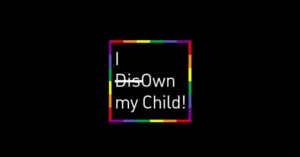
When the Serbian office of the global PR agency McCann was looking for an idea for a campaign against homophobia, they decided that reclaiming this antiquated and parochial mechanism would be an ideal way to promote just the opposite: parents’ refusal to reject their child.
In partnership with the LGBT group Da Se Zna, supportive parents ready to testify openly in the media were identified. Positive ads from these parents were then posted in the classified sections of most national and local newspapers.

Translation: I, Gordana Korać, hereby declare I would never disown my son because he loves and lives with a person of the same sex. © Instant Media Rush
A good idea always attracts attention, and the campaign’s uptake was immediate. Newspapers and TV channels noticed the campaign and ran stories about supportive parents on primetime programmes.
McCann also engaged social influencers to disseminate information on the campaign, which was, of course, highly promoted on Da Se Zna’s social media channels. This campaign attracted thousands of likes and shares and was its most successful to date.
Framing the value of acceptance rapidly became so prominent that “Not Disowning” became the theme of this year’s Belgrade Pride.
In the future, the theme could be taken even further to show that social norms are gradually shifting from rejection towards acceptance.

Translation: I, Jelica Živković, hereby declare I would not disown my daughter just because she decided not to hide the life she leads with the one she loves.
Success beyond Success
But success did not stop there. The campaign triggered responses from supportive parents across the country, who also wanted to publicly come out in support of their children. However, a lack of budget meant that all the messages could not be placed as ads. A group of these parents connected and decided to set up an organisation for the parents of LGBT children, which did not previously exist in Serbia.
Lessons learned:
- Creative agencies are often more than ready to work on themes of sexual and gender diversity. In places where the issue is a hot topic, agencies will be attracted by the “cutting edge” factor. Organisations should build contacts with all types of agencies over time, sharing their strategic plans and, if possible, their social research, as some of it might be of interest to agencies.
- Traditional references are more effective than “imported” or ready-made frames. In this case, the reference to a purely Serbian public shaming mechanism rooted the campaign in the local culture and made it authentic.
- A campaign can have spin-off effects, which should not be overlooked. In this case, the campaign led to the creation of a group of supportive parents and maybe the birth of Serbia’s “PFLAG” (Parents and Friends of Lesbians and Gays).