In 2018, India, after a long political struggle, scrapped Section 377 of their Penal Code, which criminalized homosexual behaviour. This inspired legal reform campaigns in other parts of Asia, notably in Singapore, also a former British colony.
Ready4Repeal, an online movement calling for the repeal of Section 377A of Singapore’s Penal Code, was established.
In September 2018, an online petition was launched, garnering 44,650 signatures from Singaporean citizens and permanent residents. However, in a saddening turn of events, the Ministries of Home Affairs and Law made it clear that there are no plans to repeal that section. This is not the first time that a petition has been initiated. Back in 2007, a petition to repeal the law gained 8,120 signatures in an open letter to the prime minister and 2,341 signatures in a parliamentary petition.
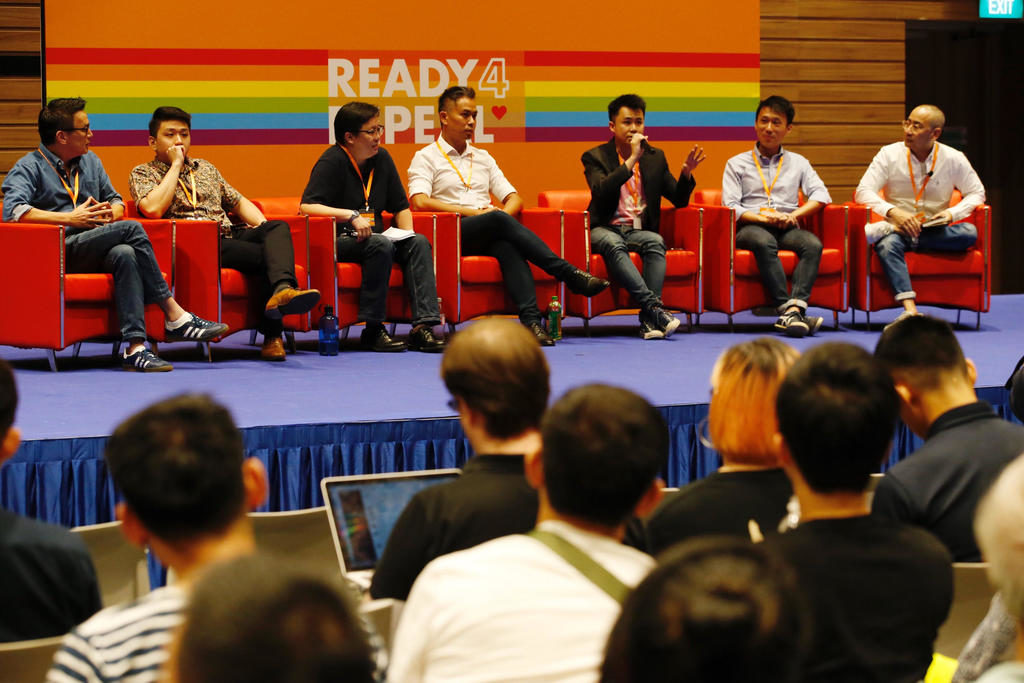
Pink Dot organized the panel discussion of the Ready4Repeal Townhall on 377A on September 30. The event was held at the School of Law (SOL) Building. © Najeer Yusof/TODAY
Although the law was hardly ever enforced, it reinforces a discriminatory environment for LGBTIQ persons. The petition’s authors, Glen Goei and Johannes Hadi, called on members of the LGBTIQ community to demand that their Members of Parliament (MPs) repeal this unjust law.
In a town hall session organized by activists, lawyer Remy Choo, who is part of the Ready4Repeal team, told TODAY that, “(The movement) cuts across political sensibilities…(and) partisan politics. I think we have made it clear that it is not a political issue. It is an issue of removing a bad law.”

© ST PHOTO- CHONG JUN LIANG
The LGBTIQ community in Singapore has found support in other places. The Buddhist Fellowship announced that they support the repeal of Section 377A on the grounds that Buddhist teaching espouses empathy, compassion, and understanding. At the same time, the support for other rights such as marriage equality is gaining approval from younger Singaporeans. A recent economic agreement on free trade and investments between the European Union (EU) and Singapore also highlighted the need to abolish laws penalizing same-sex sexual relations and ensure full protections for LGBTIQ and women’s rights.
Campaign strategies
Like other campaigns, this one relies heavily on several strategies:
- Community-led actions through storytelling of personal experiences
- Petition campaigns to call on citizens and permanent residents of the country to sign the appeal, which can be used as a political bargaining chip to convince MPs to repeal the law. In this case, the petition can be signed on the GoPetitions website with multiple translations into several languages spoken by the various Singaporean communities.
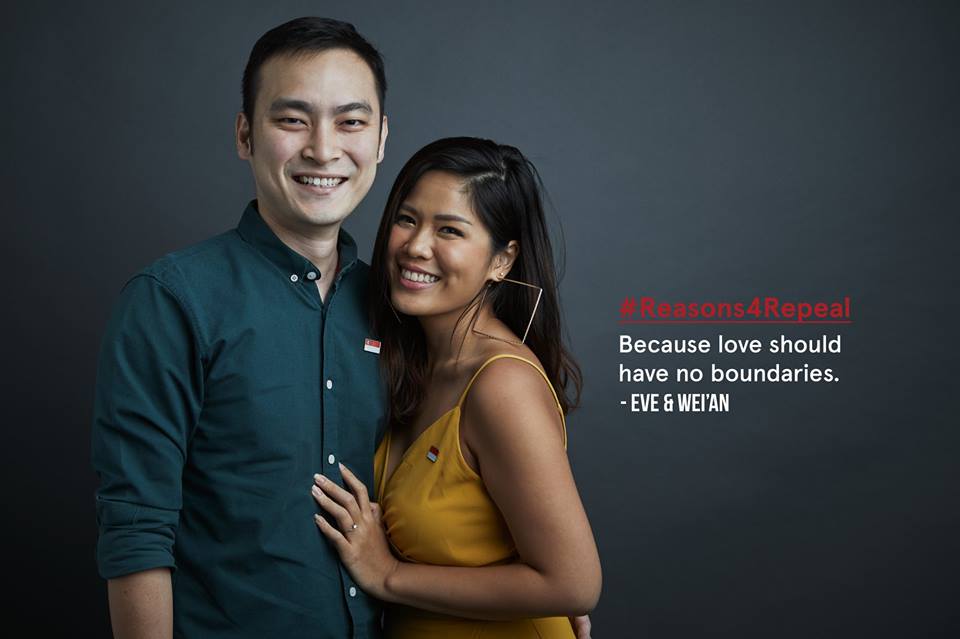
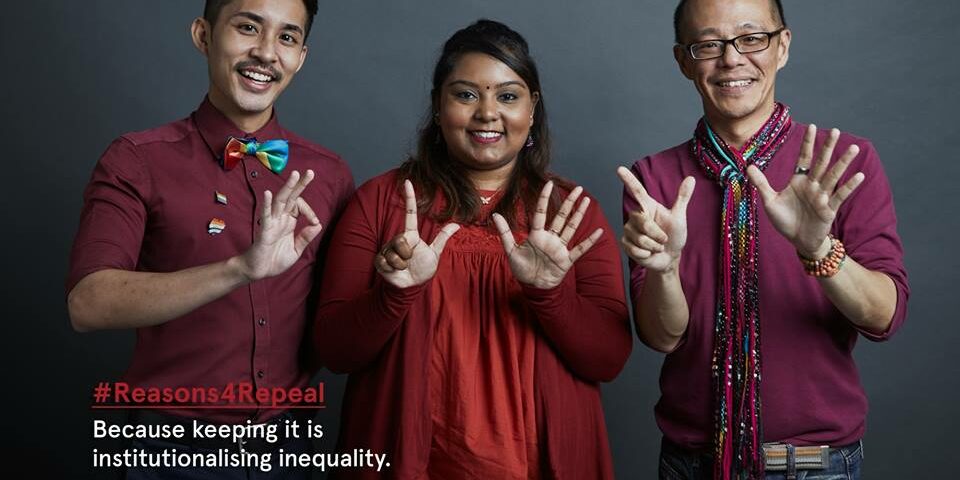
The campaign also has a strong social media presence, as the call is most visible on the Facebook page of Ready4Repeal. Another page called “Dear Straight People” gained much needed social media traction for the campaign by organizing a photoshoot called #Reasons4Repeal, showing Singaporean citizens, both heterosexual and queer, supporting the repeal of the law.
For many observers, Singapore’s future is now only a few steps away from being brighter for LGBTIQ people.
Other decriminalization campaigns
With the overarching goal of repealing Section 365A, criminalizing same-sex acts, EQUAL GROUND launched a campaign featuring short films, informative graphics, and statements of public figures supporting the LGBTIQ community.

As critical court rulings on the criminalization of same-sex acts drew closer, activists launched the #Repeal162 campaign to drum up public support for LGBTIQ equality. As organizers told Frontline AIDS, “Organisations took out billboards, there were Twitter chats, Facebook and Instagram campaigns – #Repeal 162, let it trend! We have a Repeal 162 Whatsapp group, an email list-serve, online and face-to-face forums, and conferences. So many platforms are used.”
Initially started by Amnesty International, a modeling agency, and a clothing brand to gather support against the persecution of gay men in Chechnya, Russia, in 2017, this campaign has become a global movement. Today, they sell t-shirts and other merchandise items to support the work of Amnesty and local groups fighting criminalizing laws, such as in Uganda.