Have you ever thought about organising a kite-flying day? This is another health and well-being action, with community building—as well as visibility—at its heart, which could make for a great IDAHOT activity in your town or city.
This sort of action could be done in open contexts and possibly in places more hostile to LGBTQI rights organizing. It is an interesting alternative to a public march, demonstration, or a rainbow flash balloon release. It’s also more environmentally friendly than releasing balloons.
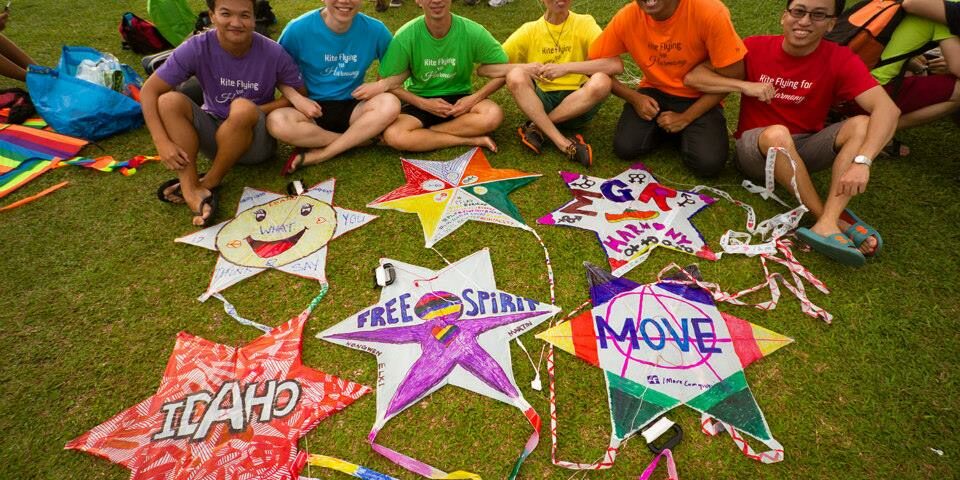
The idea comes from an action for IDAHOT 2014 in Singapore, organised by Move Community, a local activity hub for LGBT individuals, their families, extended families, and friends. We asked one of the organizers to tell us more about how they did this action, where the idea came from, and what the impact was—and they told us this great story!
How did the idea come up? What were the main assumptions behind the idea, and the main expectations?
The idea sprang from an event my niece participated in in Malaysia. I was contemplating creating something similar to promote friendships, harmony, and healthy living among LGBT and other communities for IDAHO Day. Since many of our active members love kite flying more than running, we thought it would be more interactive, so we changed it to kite flying.
What were the risks/threats/obstacles involved, and how did you mitigate them?
As we were doing it in a popular public place for kite flying managed by the Singapore government, there was a fear of being stopped by the authorities. I am happy that it didn’t stop there. I consulted the Singapore Kite Association (SKA) for their advice. I called and went down to speak to the venue receptionist to find out some facts.
How did you get it done? How much time did it take? How much did it cost? How many people did it involve? What were the tactics that you used?
It took about a month of planning, meeting, and following up with SKA, volunteers, the printer, and participants. We managed to engage SKA to teach us how to make a kite on the event day. We formed six teams and printed different colored T-shirts (based on the six rainbow colors) for the event. We spent SGD480 on printing the 30 t-shirts (about 280 Euros). About 27 people attended the event. We collaborated with another social group and invited them to join this event.
How do you rate the impact of this action, and how did you see its effects?
As we didn’t do any post-event survey or feedback, we can’t really measure the impact of this event on our communities at large. We were out, having fun flying a kite in public together with the public – straight, family, local, foreigners. It was a great achievement for me personally as I overcame some of my fears, coming out to SKA, gained understanding, engaged, and made friends. I also hope our members and friends feel more comfortable being seen out in public (with an open gay group) after the event, which many people still do not wish to do.
What advice would you give to other people who’d like to undertake this activity?
Be brave. Be OUT. Be yourself! Live OUT proud with the rainbow! No matter how small you are
If you did this action again, what would you do differently?
I have not really thought about it yet. There is a possibility of inviting different LGBT and non-LGBT groups to form teams.
You can view some more event photos on Facebook and find out more about Move Community here.
UPDATE: Kite Flying has become a popular activity across Asia, including Mumbai!
Gay Bombay’s kite flying event, now in its 14th year, is organised at the Juhu Silver Beach on the Sunday closest to Sankranti. Kite flying is a tradition at Sankranti, but this event has a twist in that the kites flown are rainbow coloured, specially ordered from Dongri. It is a pretty sight to see dozens of rainbow kites floating in the sky among all the other kites.
Their event has an awareness-raising component, as many of the public on the beach, curious about the rainbow kites, are told about it being an LGBT event for Pride. After the event, at dusk, Puri, Undhyo, and jalebis refreshments are distributed from a specially created tent, and those are the best we have experienced so far in Mumbai. The event typically attracts 150-200 community members and allies.