In some parts of the world, people whose sexual orientation or gender identity does not conform to social norms are still seen as mentally ill, despite the World Health Organization (WHO) declassifying homosexuality as such back in 1990.
To end the stigma, a powerful strategy is to reverse their argument and expose homophobia and transphobia as the real diseases.
Today, more and more people are saying that “homosexuality is not an illness, homophobia is.”
To take this argument further, an even bolder course of action is to propose a cure for homophobia.
A PRESCRIPTION AGAINST HOMOPHOBIA
 In Croatia, activists used this approach, publicly proposing a cure for government ministers known for their homophobic statements. On IDAHOT, they delivered mock medical certificates to each minister, listing all their “symptoms.” These “symptoms” included their homophobic remarks, the times they refused to make supportive statements, and the support they gave to notoriously homophobic groups, such as religious fundamentalists.
These “examinations” were accompanied by an individualized “prescription.” Treatments prescribed “one pill of open-mindedness before each meal,” “two tablespoons of tolerance to diversity when symptoms appear,” or “two anti-dogma injections each morning.”
Activists dressed as doctors handed the “prescriptions” directly to each minister as they exited the government building after a meeting, in full view of the media, so the ministers could not escape the confrontation.
INSIGHTS FOR OTHER CAMPAIGNS
This direct action allowed activists not only to call out the government but also to expose the root causes of homophobia: ignorance, intolerance, and censorship of critical thinking.
It was also a great entry point to get medical authorities, medical student unions, and psychology associations to issue supportive statements for gender and sexual diversity.
This creative mobilization can be replicated for other targets. Homophobic medical authorities could be a strategic target, as fake doctors giving them prescriptions is a smart way to question their competence.
Humor is a great way to expose the absurdity of homophobic arguments, and it works well when your target group is already quite supportive.
In Sweden, when homosexuality was still officially on the books as a disorder, campaigners suggested that people could call in sick at work, claiming they “feel a little homosexual today.”
In France, quite some time ago, when queer teachers were barred from the profession for the reason that queerness is a medical condition, a campaign playing on absurdity requested for bisexual teachers to be able to work part-time.
SIMILAR CAMPAIGNS
In other parts of the world, activists have used similar approaches to fight homophobic and transphobic rhetoric or campaign against conversion practices.
Vietnam
“Leave with Pride,” a public campaign urging health authorities to take a stronger position against conversion practices, went viral. Activists led a social experiment, where queer volunteers filed for sick leave with their employers with a prescription from a doctor.
Mexico
Young activists started the “Nothing to Cure” (“Nada que Curar”) campaign, which forms an integral part of their work towards ending conversion practices. To gather public support, they launched the hashtag #NoEstoyEnfermx (#ImNotSick) on social media and in public spaces.

Buses in Mexico City displayed art of queer love with the message, “Homosexualidad no es una enfermedad” (Homosexuality is not a disease).
China
In a rare public protest, trucks traveled around the country and stopped by “conversion therapy” clinics, with messages inviting passersby to reflect on conversion practices as curing a disease that does not exist.

Trucks with bold slogans opposing conversion practices went through major cities across China. © AFP/Getty Images
United Kingdom
A campaign in Scotland focused on affirmative messages to counter the damaging narrative of conversion practices, telling people, “You Are Loved.”

A digital billboard in a Scottish highway displays affirming messages and contact details for LGBT+ Helpline Scotland. © Shape History
Germany
To campaign for a legal ban on conversion practices, Travesty for Germany, a collective of drag artists, released a series of posters, with messages such as “Why fix what is not broken?” and “Homophobia is curable.”

Drag artist Jacky-Oh Weinhaus stuns in a poster demanding, “Why fix what is not broken?”
Canada
In Montreal, a satirical campaign had an ambitious call: ending LGBTQphobias for good. Activists humorously depicted homophobia and transphobia as irrational fears requiring treatment.

A poster humorously depicts anti-LGBTIQ hate as an irrational fear.
Global
In 2023, global advocacy groups MPact & GATE started an initiative to gather public endorsement for the call that “Homophobia & Transphobia Are A Public Health Crisis.”

A social media card emulates an emergency alert warning about homophobia and transphobia as a public health crisis.
Brazil
When a Brazilian judge ruled to legalize treatments claiming to “cure” gay people, it made international news, sparking widespread protests. In 2017, a celebrity collaborated with activists to create a t-shirt sending out a simple message that being gay is not an illness to be cured. The shirt says “Cura Gay,” which means “Gay Cure.”
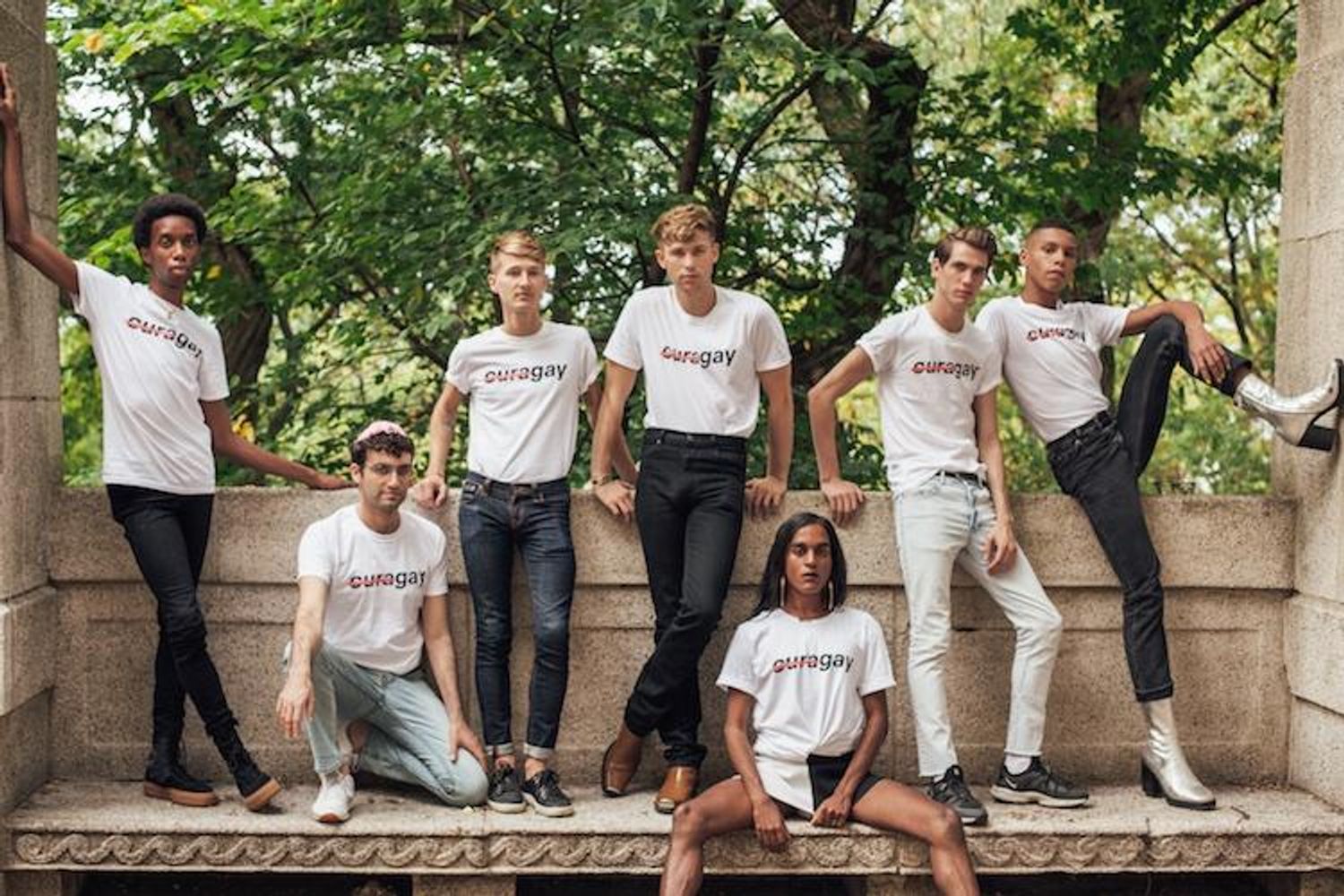
Activists model the “Cura Gay” t-shirts. © Jack Hunk
More recently, in 2024, a Brazilian artist released “The Cure,” a short film exposing the horrors of conversion practices, aiming to gather support for legislation banning them.