A photography competition could be a great way to encourage participation from the community, change public attitudes, and promote discussion, while promoting diverse images of LGBT people on social media.
In Myanmar, different LGBT associations came together for IDAHOT 2014 to create a pioneering photo competition. Called the “&Proud” Photo competition, the event was part of a diverse series of events around May 17 across the country. Organised in the capital, Yangon, it helped to promote alternative images of LGBT people, encourage participation in rights and culture projects, and create space for community-building.
We asked the organisers more about how they came up with the idea, and how they organised it. And they told us this inspiring story…
Where/how did the idea originate? What were the main assumptions behind the idea, the main expectations?

First prize in Series – &Proud Photo Competition, Yangon. © &Proud
We always wanted to organize a photo exhibition to let the people in the country know that we are here among the citizens, and we are the same as you and as proud as you. So, Colors Rainbow and YG event decided to organize that. We had a few aims with the photo exhibition. Firstly, there are not many cultural events for LGBT people in Myanmar, so we felt that it was a good event for people to meet each other and discuss LGBT issues and culture. Secondly, we wanted to show the broad range of LGBT identities. People, certainly in Myanmar, often have a very limited idea of what it means to be LGBT. We felt that photos would be a very personal way of showing people the many different meanings of being LGBT. This links to the third aim, which was to also cater to non-LGBT people. We had quite a bit of media coverage, and a good number of interested people came to watch the exhibition. With this, we hoped to bring the LGBT community closer to ‘everybody else’s’ lives. Lastly, we wanted to boost photographers’ interest in documenting the LGBT community in Myanmar, as well as give amateur photographers a chance to show their own take on the community.
What were the risks/threats/obstacles involved, and how did you mitigate them?
We did not have any risks/threats/obstacles. However, we were quite worried that there would be only a few photos that would come in, but we received 44 photos, which is ok for a first competition for the LGBT community. For the exhibition, we had the photos that were submitted for the competition, as well as the award-winning photo series “The Pink Choice” from Vietnam. With this series, the photographer Maika Elan won a World Press Photo award for best contemporary series – pretty much the highest achievable award for photographers. By combining the local photos with a professional exhibition, we had more certainty of having an interesting mix of photos, and we were able to show an outside perspective as well.

First prize in Singles – &Proud Photo Competition. Courtesy of &Proud
We will keep doing this competition every year. And after all the positive responses from the photo competition, we are now organising the &Proud LGBT film festival, which will be held on 15 and 16 November this year.
How did you get it done? How much time did it take? How much did it cost? How many people did it involve? What were the tactics that you used?
It took three months, including preparation time, although it is advisable to take some more time. We had about five weeks for photographers to send in photos, but if you want photographers to take photos specifically for the competition, it is advisable to send out the call for photos a little earlier.
There were three people from Colors Rainbow involved, two from the YG event, and the gallery owner has been a huge help. Besides that, we’ve had some help from friends, of course.
Our costs were around $2,500 USD. The major costs were: $1,100 for prize money (total of 5 prizes), $500 to get the photos from the Vietnamese photo series printed as they had to be printed in very high quality, $70 to get the competition photos printed, and $300 for the rent of the gallery space. It can be organised on a quite low budget, certainly if you can find a cheap gallery and when printing costs are low.
How do you rate the impact of this action, and how did you see its effects?
It has had positive effects, which have caused a slight change to the people in Yangon. They expected something weird, strange, or pictures of make-up artists, but what they saw was something they did not expect from the LGBT community. We had over 200 visitors in our eight-day exhibition, which is quite a good turn-out for Yangon. Besides that, we reached people through TV and newspaper coverage.
What advice would you give to other people who’d like to undertake this activity?

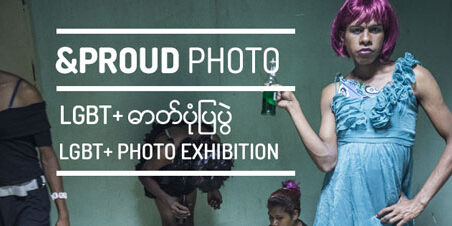
Poster for the &Proud Photo Exhibition in Yangon, Myanmar, for IDAHOT 2014. © &Proud
Just go for it! It is relatively easy to organise, and there are probably more people with photos from the LGBT community than you think. We accepted photos that were up to two years old, and accepted both amateur and professional photos. We had two categories: series and single shots. In both categories, we had two prizes. It’s nice to let amateurs enter the competition, because it lets the LGBT community show photos of themselves. As mentioned before, it is a really good idea to combine it with a regular exhibition of LGBT photos from another country, as that will give the exhibition more body and will help if the quality of the entries is too low. Lastly, there’s also a possibility of combining this with a masterclass or workshop for young photographers.
If you did this action again, what would you do differently?
One of the things we would like to change is to focus more on photos from LGBT people themselves. It would be nice to have a lot of photos from amateur photographers who take photos of themselves and their friends. Next year, I hope we’ve got a wall full of amateur photos – preferably a wall with photos of a lot of happy and confident people who are not afraid to show their identity to the world.