Interview with Paerin Choa, Pink Dot Organising Committee:
Pink Dot Singapore is an annual, non-profit, free-for-all event that started in 2009 in support of the LGBT community in Singapore.
It’s run by an organising committee of about 15 volunteers, with the support of up to 500 volunteers for the event itself.
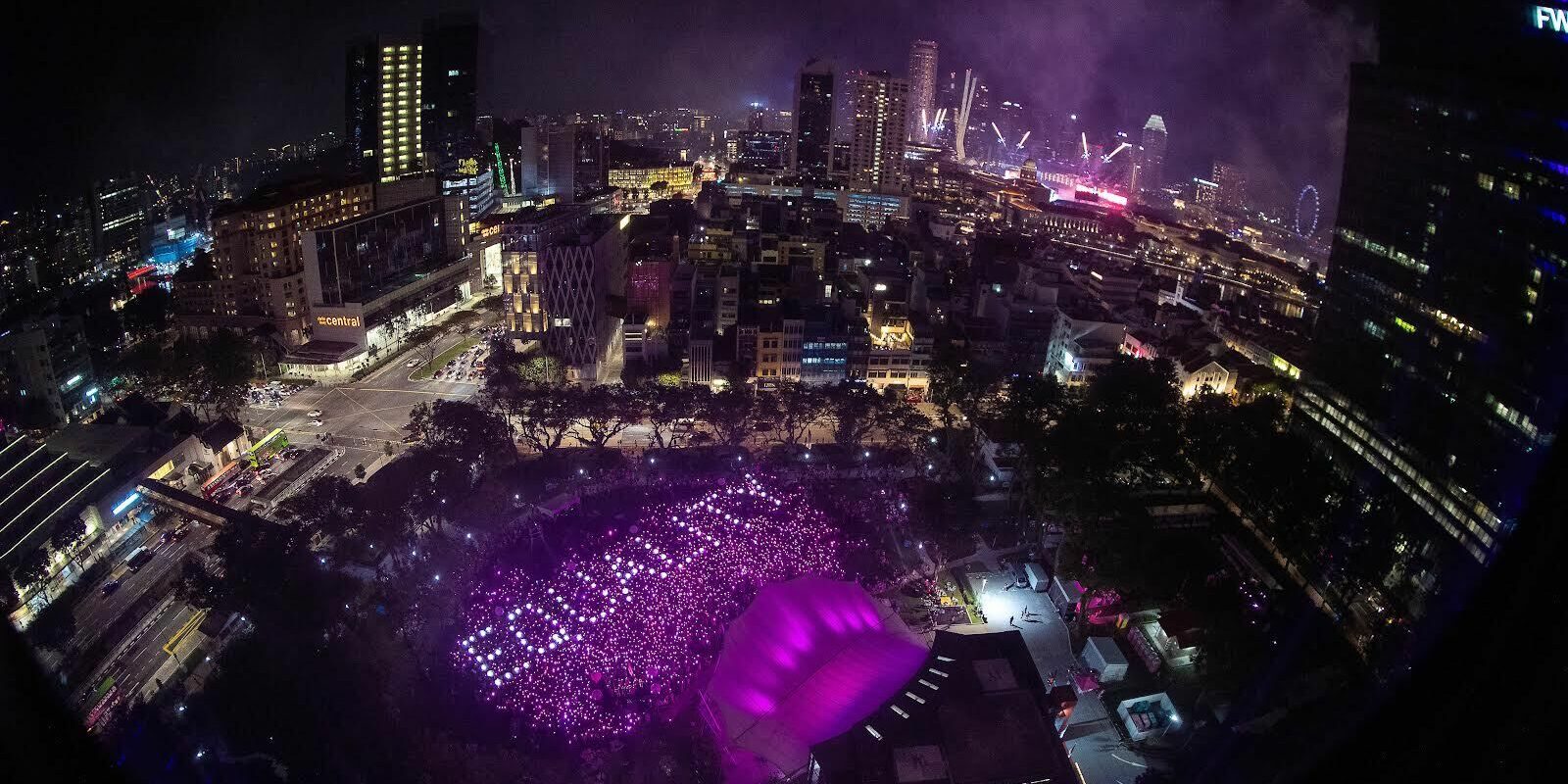
Attendees gather to form a human “pink dot” to support inclusiveness, diversity, and the freedom to love.

This event was made possible when, in September 2008, the rules governing activities conducted at Singapore’s Speakers’ Corner at Hong Lim Park were relaxed. This allowed demonstrations organized by Singaporeans to be held at the park, provided that all participants are either citizens or permanent residents. This allowed the first Pink Dot SG event to occur at the Speakers’ Corner on May 16, 2009.
At that time, authorities opposed progress on the rights of sexual and gender minorities, including the decriminalisation of same-sex acts, because Singaporean society was supposedly conservative.
Thus, the initiative aimed to be a platform for the increasingly liberal, progressive public to change the hearts and minds of Singaporeans and to chart the evolution of society.
From the very outset, it was important for organisers to show that the initiative was deeply local, in response to the mainstream opinion that sexual and gender diversity are concepts “imported from the West.”
The image of the Pink Dot was chosen to refer to Singapore’s nickname as the “little red dot.” The color pink can also represent the merging of the red and white of the Singaporean flag.
Aside from the titular formation, Pink Dot events usually also feature concert performances and community booths by organizations supporting the LGBT community and cause.

The event grew organically from 2,500 attendees in 2009 to 4,000 the year after, to a whopping 26,000 in 2014. Google spontaneously sponsored the event from 2011 onwards, followed the year after by Barclays and later by JPMorgan, Goldman Sachs, BP, and others. By 2016, it was supported by 13 major international corporations.
This resulted in Pink Dot being the only Singaporean event sponsored simultaneously by competing businesses. For some sponsoring companies, supporting Pink Dot provided a first stepping stone in supporting sexual and gender diversity, gradually expanding to full-fledged company policies for Diversity, Equity, and Inclusion (DEI).
Throughout the years, the Pink Dot events have applied a fundamental campaign principle: be regular to build on past momentum, but innovate to avoid fatigue. So, after three consecutive renditions, the organizers decided that in 2012, the Pink Dot would be nocturnal, with 15,000 participants forming a glowing pink dot with mobile phones, torches, and flashlights. This provided a good variation and re-energized participants.

In 2014, Pink Dot innovated again. In addition to the traditional pink dot formation with torches, the 2014 event included a blue heart within the pink dot. It also featured a “Community Voices” segment, where speakers from Singapore’s LGBT community and straight allies were invited to share their stories.
In 2015, participants formed the word “LOVE”. Two years later, in 2017, Pink Dot formed a rainbow within the “sea of pink.”

These variations also responded to the need for each year to have its specific visual identity so that the initiative’s evolution could be easily shown. Initially, the evolution was meant to be only about the size, as organizers hoped to gradually fill up the park in 10 years. The reality was that the park was already overflowing merely three years later, so organizers had to find other ways to give each rendition its own visual identity.
The Pink Dot initiative illustrates well how important the “branding” of a campaign is. The visual effect of the Pink Dot is obviously at the heart of the success. This is not only because it makes for great photos (which is perfect for media coverage), but also because it allows all participants to be uniquely part of the action. The emotional connection with the participants was further reinforced by the design of the Pink Dot SG mascot “Pinkie.”

Although there has never been a proactive media strategy, the media coverage has always been extensive, especially taking into account that Singapore’s censorship laws forbid any media in the country from portraying sexual and gender minorities in a positive light. Fortunately, many Singaporeans are connected to the international press and don’t face this restriction. But for members of the Chinese, Indian, and Malay communities who are linked mainly to either local media or media in their primary language, this censorship actually results in a blackout of positive information, so social media obviously played a significant role in getting favorable coverage out to every corner of the nation.
As could be expected, success brought its toll: Pink Dot 2014 was the first year the event drew strong flak from Singapore’s Muslim and Christian communities. These religious communities voiced disagreement with the event and staged a counter demonstration with a “White White” event where participants dressed in white. This led organizers to start taking security measures.

While the opposition from Christians was longstanding, and the result of a handful of very vocal, rich and pinfluentialindividuals, the mobilisation by Muslims came more as a surprise, as this community is traditionally rrelativelylow-key. Their mobilisation soon died out, with only one church continuing the protest in subsequent years.
As is often the case in campaigns, the opposition also generated support from more moderate groups, in this case, progressive religious communities that felt they had to take alternative positions on the need to accept diversity.
In 2017, authorities started cracking down on the event. The Ministry of Home Affairs banned foreign residents and entities from organising, supporting, and participating in the event, stating that LGBT discourse in the country should be restricted to its citizens. So, only Singaporean citizens and permanent residents were permitted to attend the rally; the identity cards of each participant were verified at the various checkpoints when they entered the barricaded park.
In addition, foreign companies such as Airbnb, Apple, Facebook, Goldman Sachs, Google, Microsoft, NBC Universal, Salesforce, Twitter, and Uber were not permitted to sponsor the event. Despite the new regulations, 120 Singaporean companies donated to the event, making up for the loss of contributions from multinationals. Responding to the “Red Dot for Pink Dot” campaign, these companies mobilised partly to express their opposition to the restrictions that Pink Dot had to face.
However, these new measures also provided an excellent opportunity to garner more support and momentum.
While organizers at one stage feared that the Government crackdown would deter participants, the park filled up in four hours, and organizers soon had to turn people away.
Though this was not intentional nor the result of a willful strategy, this nicely illustrates how, sometimes, you can use opposition to generate more momentum from your supporters.
This video nicely shows how this worked:
Last but not least, Pink Dot events throughout the years have applied another important campaign lesson: Be very consistent in the values that a campaign promotes. In this case, the central value consistently flagged is the freedom to love.
To support this, other related values have been promoted, often in line with the specific contexts in which the Pink Dot took place. These values include Family Love and Solidarity, Peace, Acceptance, Unity, Patience, and Dialogue. The non-confrontational tone is strikingly visible in all campaign materials and media coverage. The systematic playing of the national anthem also brings in the very important values of national unity and respect.
For a summary of Pink Dot, watch this short and concise report by BBC News: