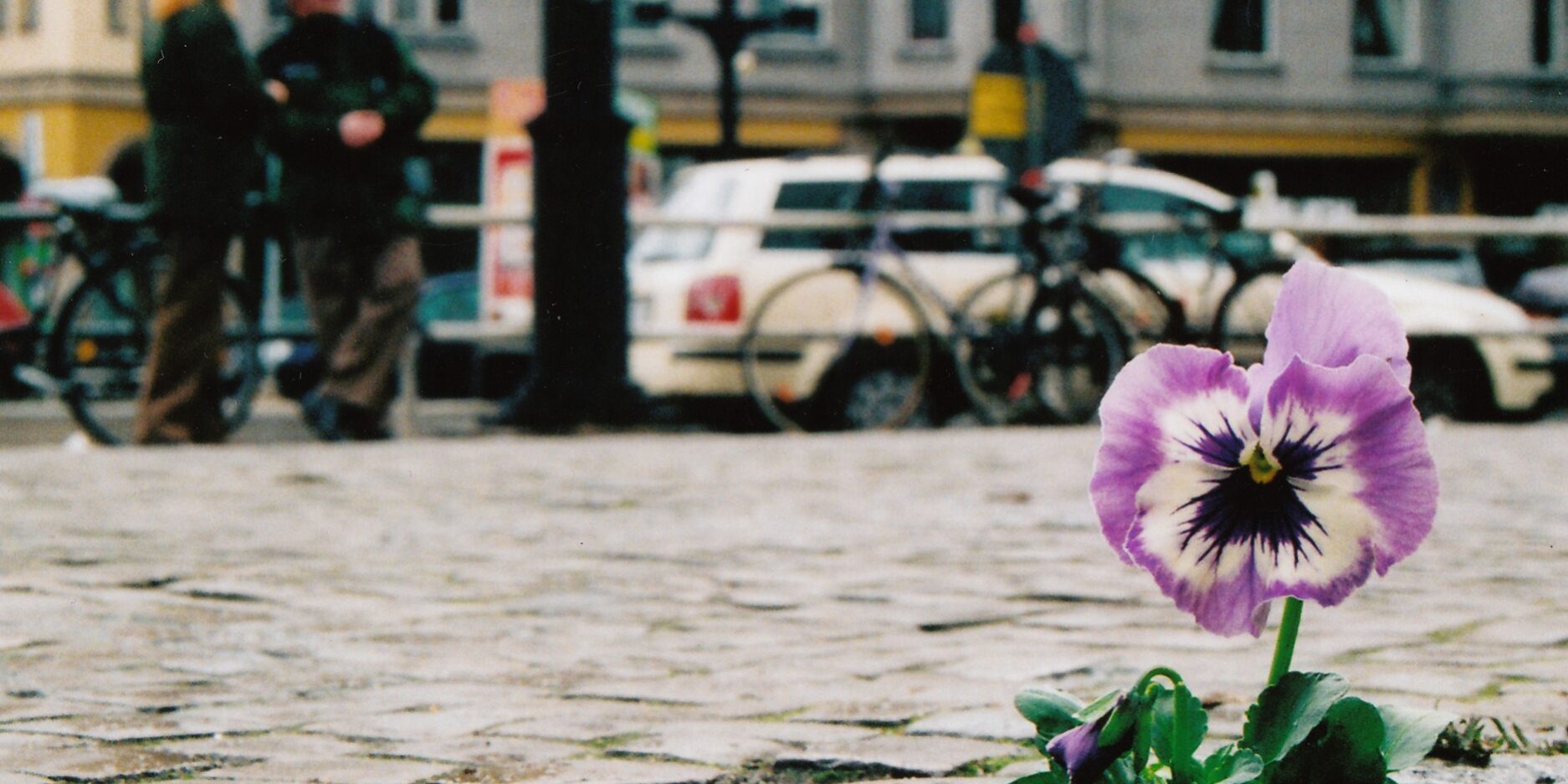
In recent years, “guerrilla gardening” has become more popular, with people planting flowers and trees as a symbol of protest and to come together as a community and reclaim public spaces. When a single flower blooms in a place marked by hatred, a symbol of hope stands out in pride and becomes a “gesture of quiet resistance,” explains artist and creator of The Pansy Project, Paul Harfleet:
“Artist Paul Harfleet plants pansies at the site of homophobic abuse, he finds the nearest source of soil to where the incident occurred and generally without civic permission plants one unmarked pansy. The flower is then photographed in it’s location and posted on this website, the image is entitled after the abuse. Titles like ‘Let’s kill the Bati-Man!’ and ‘Fucking Faggot!’ reveal a frequent reality of gay experience which often goes unreported to authorities and by the media.
This simple action operates as a gesture of quiet resistance, some pansies flourish and others wilt in urban hedgerows. The artist began by planting pansies to mark his own experience of homophobia on the streets of Manchester (UK) though he plants pansies for others both on an individual basis and as part of various festivals and events. Perhaps most poignantly The Pansy Project also marks locations where people have been killed as a result of homophobic attack, for example a pansy for Michael Causer who was murdered in Liverpool in 2008.” – from The Pansy Project
Paul and other “guerrilla gardeners” in various countries have often taken this kind of action to mark IDAHOT. In 2013, for example, Pansy Project workshops and actions took place in the UK, South Africa, and South Korea. Meanwhile, in 2014, Pansies were planted for IDAHOT in Bristol, London, and Brussels.

Guerrilla Gardening for IDAHOT 2013, in the Jongro area of Seoul, South Korea, by the Korean Gay Men’s Human Rights Group,
Pansies are a significant choice of flower because, in English, a “pansy” is also a (quite old-fashioned) slur for “gay.” So the planting of pansies, as symbols of hope against anti-LGBT violence and discrimination, also works to turn that prejudiced meaning around. The same is true in various languages.
In Spanish, for example, the pansy is called “el pensamiento” (deep thought), which is also used as a slur for feminine, gay, or bisexual men. In French, the flower is also associated with thinking and thought (la pensée), as well as male femininity or homosexuality. In Portuguese, the flower is called “amor-perfeito” (perfect love), and carries connotations of feminine and queer as well.
Pansies are also usually relatively cheap, and May is a great time to plant them!
Choice of flower
Other flowers might also be meaningful choices depending on the issues you want to address. From roses, daffodils, and tulips to sunflowers, orchids, and lilies, you can find out more about plant symbolism in this handy Wikipedia page. Meanings often vary by culture. Hanakotoba is the Japanese language of flowers, for example.
Planting a tree or seeds
Planting a tree or sowing seeds together as a community might also be an enjoyable group activity to mark May 17 and leave a mark of your fight against hatred for the future. Like with the Pansy Project, this could be done as an act of remembrance and hope against violence at the site of a hate crime. You could also plant as an act of community expression and a way of coming together, in a public park, for example.
Shape, colour, and form
Another option could be to plant flowers in a meaningful shape or form, such as a heart, or to plant different coloured flowers together, in separate rows, to make up the colours of the rainbow flag.
When David Morley was killed in a homophobic hate crime in London in 2007, Paul planted a thin pink line of 3,000 pansies along London’s South Bank in a form that traced his last steps.

Pansy! For David Morley. Courtesy of The Pansy Project
Permission and security
As this is an act of adding something to public spaces, it is unlikely to be met with repression or require permission from authorities.
So, where freedom of expression, assembly, and association for LGBTI communities are restricted, “guerrilla gardening” can be a significant – and effective – way of expressing yourself and making your mark, visually (and in an eco-conscious way), in a public space, without it being repressed as a “protest.”
Please do, however, consider these risks in your own context.
Alternatives
In the same vein, you can get people together in an unused or unkept public space, where there is soil to plant with, and to “occupy” the space through gardening and other activities like clearing up, sculpting, or building a public bench.
In São Paulo, Brazil, for example, there is a whole movement of people who come together to do this on certain days. It is a great way of bringing people together from different generations.
Further resources
For more information, including tips on selecting your site, planting your pansies, and taking the best possible photos, see the Pansy Project website!
And remember to send us a picture of your event at contact@dayagainsthomophobia.org so we can share it more widely. If you’re organising for May 17, you can also use the hashtags #PansyProject and #IDAHOT to help get your message out.
Main Photo: Courtesy of the Pansy Project